
Introduction
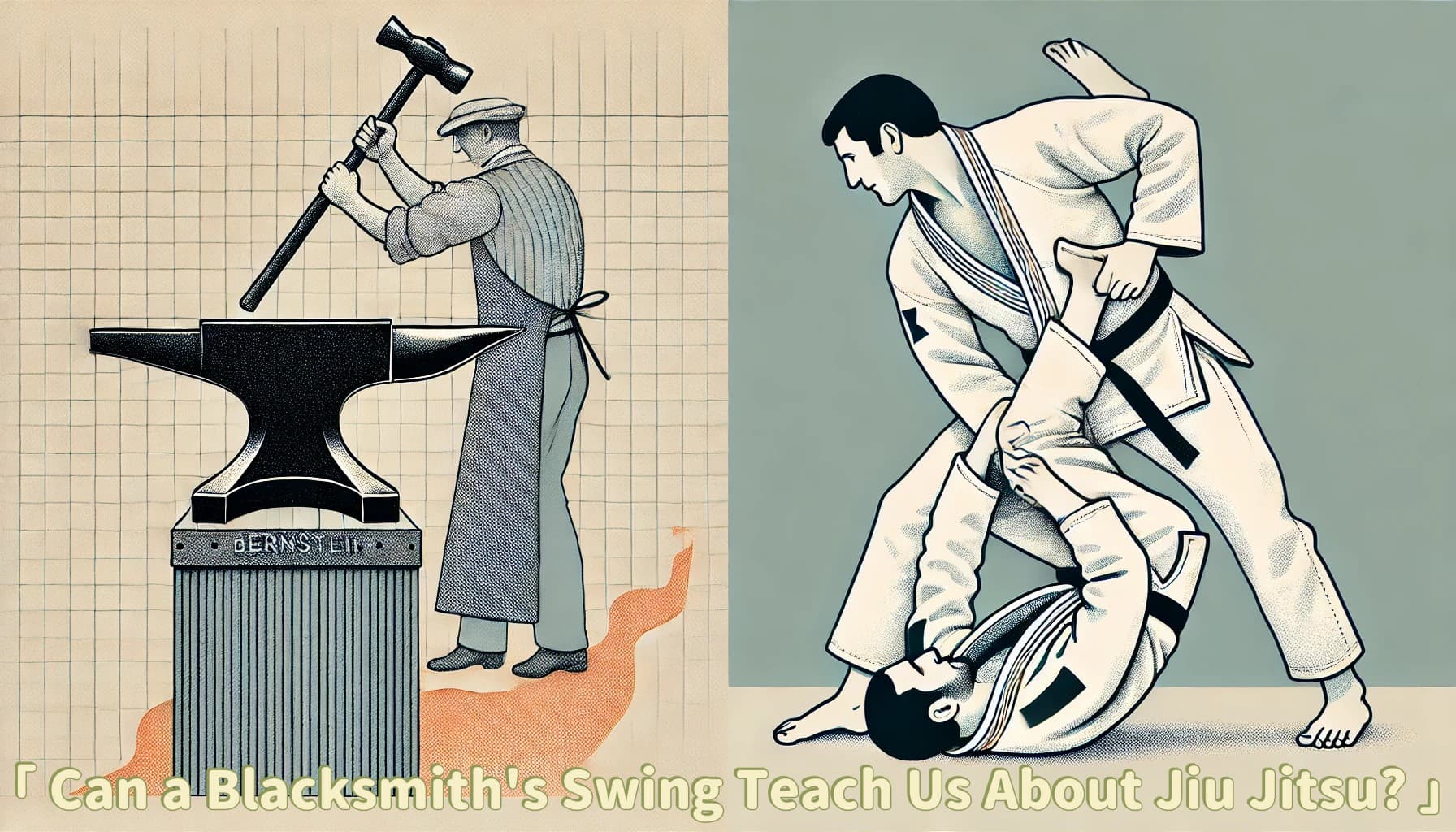
Imagine spending your days as a blacksmith, swinging a hammer with precise aim to hit the same target, hundreds of times over. You’d assume each swing would start to look identical, right? Surprisingly, one of the most influential scientists of the 20th century, Nikolai Bernstein, discovered that this wasn’t the case. No two swings were exactly alike, even among experts. In fact, Bernstein found that experts actually have more variability in their movements than beginners. This finding redefined what it means to 'perfect' a technique, especially in dynamic fields like martial arts. Today, we’ll dive into Bernstein’s revolutionary findings and see how they transform the way we approach jiu jitsu and MMA training.
The Blacksmith Study: A Closer Look at Skilled Movement
Nikolai Aleksandrovich Bernstein (1896–1966), a pioneer in biomechanics and motor control, studied the movements of skilled workers—including blacksmiths—in action in the 1920s. Bernstein used high-speed cameras and light markers attached to his subjects’ joints to analyze their movements in detail (as seen in Figure 1), revealing fundamental insights into how our bodies coordinate movement.
Figure 1: Bernstein’s Blacksmith
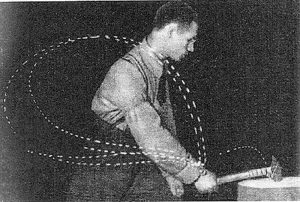
Cyclogram of Aleksei Gastev, Bernstein’s blacksmith, cutting metal with a chisel and hammer in the laboratory of the Central Institute of Labor. Source: Wikipedia
Repetition Without Repetition: The Power of Variability
Bernstein observed that skilled movements aren’t identical each time, even though they produce consistent results. Instead, each repetition adapts slightly to fit the specific situation, a phenomenon he called ‘repetition without repetition.’
Interestingly, experts actually have more variability in their movements than beginners. This may seem counterintuitive, but it’s key to what makes their performance so effective. For beginners, movements tend to be more rigid, as they focus on following a “correct” technique. Experts, however, focus on completing the task itself—such as hitting a precise target.
Before Bernstein’s research, most believed that consistency came from identical repetition. Bernstein showed that adaptability, not rigid repetition, is what makes performance consistent, transforming our understanding of skill development in sports and martial arts.
The Degrees of Freedom Problem and Context-Conditioned Variability
Another of Bernstein’s key discoveries was the “degrees of freedom” problem. The human body has about 650 muscles and 350 joints, each capable of moving in various ways. For a task like swinging a hammer or throwing a punch, the body has endless options—should you swing mostly from the shoulder, elbow, hip, or wrist? Stand with your feet squared or staggered? With so many possibilities, how does the body produce precise, controlled actions without becoming overwhelmed?
Figure 2: The Degrees of Freedom Problem–The Armbar
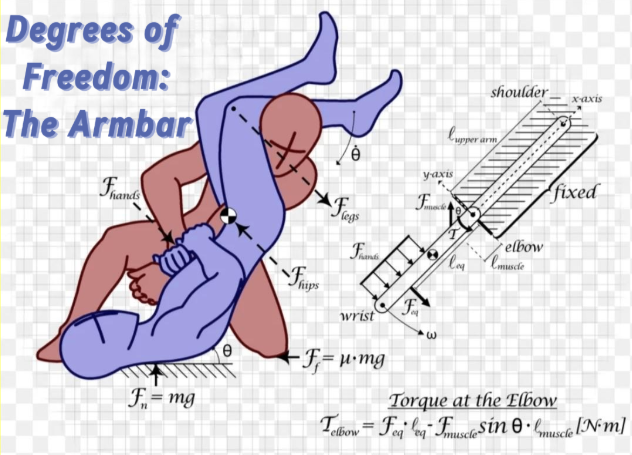
Source: Reddit, modified by Ground Game Theory
Bernstein defined motor coordination as “the process of mastering redundant degrees of freedom of the moving body, converting it into a controllable system.” In other words, effective movement requires learning to control these options so that the body functions as a cohesive, manageable system.
Moreover, Bernstein recognized the importance of context-conditioned variability—the body’s need to adapt movements to changing conditions. These conditions could be internal (like muscle fatigue) or external (such as an opponent’s unpredictable actions).
Bernstein’s Solution: Three Stages of Motor Learning
To handle this complexity, Bernstein proposed that the body naturally progresses through three stages of motor learning, gradually expanding its control and flexibility. Importantly, while these stages reflect the body’s natural way of learning, they also provide a roadmap for structured training that supports efficient skill development:
1. Freezing Degrees of Freedom
At first, the body reduces the number of movement options by freezing certain muscles and joints. This can happen in two ways:
Fixing Specific Joints: Beginners might lock certain joints or muscles, like keeping the neck stiff during a double leg takedown, effectively "freezing" that part. This reduces the degrees of freedom, making the movement more stable but limited.
Coupling Movements: Another strategy is to make two body parts move together as one unit, like extending the ankle and knee simultaneously during a jump. This reduces complexity by combining movements into a single choice.
While freezing degrees of freedom makes movement easier to control, it limits flexibility and power. As skills develop, the body begins to unlock more options in the next stage.
2. Freeing Degrees of Freedom
In this second stage, the body “unfreezes” previously locked parts, allowing for greater flexibility and adaptability:
Controlled Release: The body releases joints in a structured order, often starting with those closer to the center (proximal to distal) or from the head down (cephalocaudal). This gradual release improves control without overwhelming the body.
Functional Couplings (Synergies): The body also forms task-specific synergies, or combinations of movements, for different tasks like striking or grappling. This allows efficient movement while reducing the need to control every joint individually.
At this stage, movements become smoother, and athletes gain the ability to adapt in real time to dynamic situations.
3. Exploiting Reactive Forces
In the final stage, the body begins to harness natural forces like momentum, gravity, and inertia to make movements more powerful and efficient. Rather than relying solely on muscle strength, advanced athletes use these “reactive forces” to work with the body’s natural mechanics.
For example, in a roundhouse kick, the rotation of the hips creates momentum that travels up through the torso, which guarantees a degree of rotation in the shoulders and naturally carries the leg through the kick. This means the kicker doesn’t need muscle alone to move the leg; they exploit the kinetic link between the hips and upper body. By using these reactive forces, MMA fighters achieve greater control and efficiency, as forces generated in one part of the body can drive movement in another.
This final stage enables athletes to handle context-conditioned variability most effectively. By building on the stages of freezing and freeing, this stage allows for a high level of adaptability and mastery, where the body instinctively uses external forces to enhance performance and respond fluidly to any situation.
Bernstein’s Lasting Impact on Skill Development
Although Bernstein didn’t directly create ecological dynamics or the constraints-led approach (CLA), his insights laid the groundwork for both. His findings inspired ecological psychology’s concept of perception-action coupling, where athletes adapt to their environment in real time. Later, Karl Newell’s CLA expanded on Bernstein’s ideas, using task, environment, and individual constraints to guide learners toward adaptable solutions. Today, these principles are essential in sports training, promoting live, situational practice over static drilling.
Since Bernstein’s pioneering work, numerous studies have validated his concepts across various sports, confirming that adaptability—not identical repetition—is key to skill development. Here are a few examples:
Freezing and Flexibility in Skill Acquisition: Vereijken et al. (1992) observed that beginner skiers often "freeze" certain movements, gaining flexibility as they improve. Link.
Dynamic Adaptability in Sports: Studies in basketball (Chiang & Liu, 2006) and baseball (Gray, 2020) show that athletes increase movement flexibility as they progress, supporting Bernstein’s model of adaptable control. Link 1. Link 2.
Motor Synergies and Feedback: Ranganathan & Newell (2008) found that feedback-driven adjustments in movement reinforce Bernstein’s theory of adaptive control. Link.
These studies reinforce that the principles of adaptability and motor variability apply across fields, underscoring Bernstein’s ideas as essential to skill development. Yet, some in the Jiu Jitsu community remain hesitant to adopt the CLA, often citing a lack of Jiu Jitsu-specific research. But this raises a compelling question:
Is Jiu Jitsu truly exceptional in how we learn movement?
Are traditional Jiu Jitsu techniques so unique that they defy the very principles of human biomechanics and adaptability?
Related Posts for Practical Application in Jiu Jitsu
For more on applying these principles in your jiu jitsu training, check out our previous posts:
The Biggest Jiu Jitsu Lessons We Learned: Learn how the ecological approach shifts focus from rote memorization to adaptive, real-time problem-solving, helping practitioners develop resilient skills that thrive under pressure. Includes task-based game templates and examples.
Jiu Jitsu Growth Hack: The Power of Training Density: This post mathematically breaks down how increasing training density through situational sparring with constraints can dramatically speed up skill development.
Conclusion
Bernstein’s studies on human movement taught us that skill development isn’t about perfect repetition but about adapting to changing situations. There is not an ideal technique or form to strive for, because no two situations appear the same in dynamic fields. His concepts of adaptability and functional variability have inspired modern methods like ecological dynamics and the constraints-led approach, offering a redefined roadmap for skill development in modern MMA and jiu jitsu training. Embracing these methods isn’t a break from tradition but an evolution—a deeper dive into the science of skill that brings us closer to true mastery.
Get ahead of the curve. Rethink how you train—before it’s too late.
Elevate Your Grappling Skills
Ready to reshape your approach to grappling? With the ecological method, you'll not only improve adaptability and reactions but also tap into creative, fluid movement on the mats. At Ground Game Theory, Miami’s top martial arts academy, we specialize in No Gi Jiu Jitsu and MMA for all ages and skill levels. Join us for a free trial and discover a new way to evolve your skillset.
Learn more by following any of the links below ↓
Website: groundgametheory.com
Instagram: instagram.com/groundgametheory
Facebook: facebook.com/GroundGameTheory
YouTube: youtube.com/@groundgametheory
TikTok: tiktok.com/@groundgametheory
Threads: threads.net/@groundgametheory
X (Twitter): x.com/GGT_Miami