

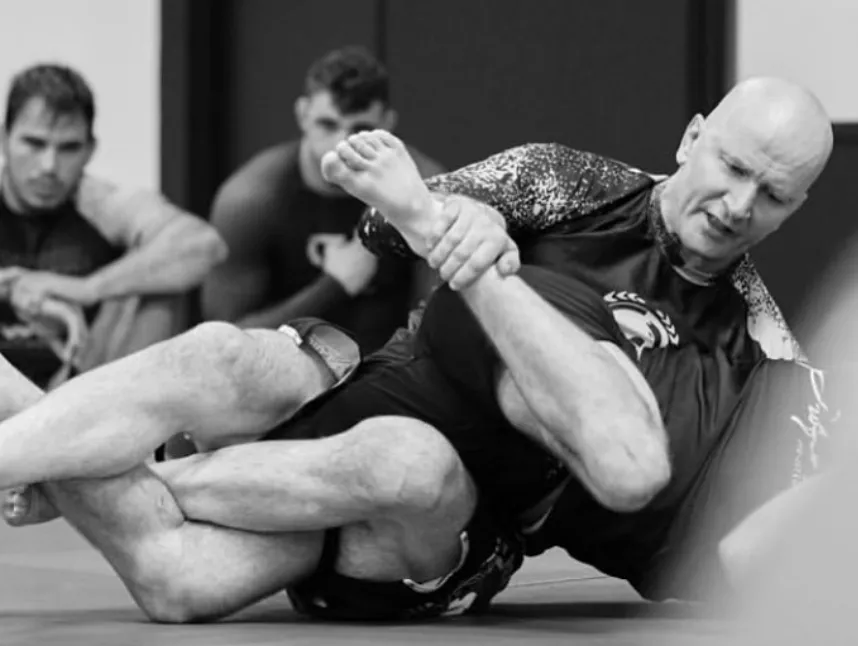
John Danaher, a legendary Brazilian Jiu Jitsu professor renowned for his innovative teaching methods and deep understanding of the art, inspired the following insights in this article. We will explore some of Danaher's most profound teachings and what we can learn from them.
There Are No Shortcuts to Success in Jiu Jitsu
We cannot neglect the importance of hard work and dedication in Jiu Jitsu. Success is not possible through shortcuts or quick fixes but through consistent effort over time. This lesson is particularly relevant for beginners looking for a quick way to improve their skills.
Focus on Fundamentals
Fundamentals are the foundation of any dangerous Jiu Jitsu game. Grapplers should initially aim to understand and master basic techniques like pin escapes, guard retention, takedowns, and submissions. By focusing on the fundamentals, practitioners can build a solid base and develop a deep understanding of the art.
Train Smart, Not Just Hard
While hard work is important, we must also work intelligently by planning and strategically approaching our training. For example, rather than just rolling aimlessly, we should focus on specific techniques or positions we want to improve. By being intentional in our training, we can make better use of our time and make more progress in our Jiu Jitsu journey.
Develop a Systematic Approach
Danaher is known for his systematic approach to Jiu Jitsu, which involves breaking down techniques into smaller components, i.e., the first principles, and building them back up. He believes that this approach helps students develop a deep understanding of the art. In one video, he explained that "you can break things down into a series of smaller movements and really work on them in a systematic fashion" (BJJ Fanatics, 2020). In No-Gi Jiu Jitsu, this might mean developing a system for passing the guard or submitting opponents from specific positions. By developing a systematic approach, practitioners can better use their training time and progress more quickly.
Emphasize Positional Sparring
Positional sparring is one of the most effective ways to improve at Jiu Jitsu. This type of sparring might involve starting in a position like the closed guard or back control and working on particular techniques or strategies. By sparring from specific positions rather than starting in a neutral position, practitioners can develop a deeper understanding of the intricacies of a given position and excel faster. In one video, Danaher stated that "positional sparring is where we really put the rubber to the road in terms of developing specific skills" (BJJ Fanatics, 2020).
Jiu Jitsu Is a Mental Game as Much as a Physical One
Mental toughness is another essential trait to improve in Jiu Jitsu. While physical skills are necessary, having a solid mindset to stay calm and focused under pressure is also crucial. A great way to develop mental toughness is by practicing visualization, setting goals, and developing a positive mindset.
Jiu Jitsu Is a Team Sport
Despite being an individual sport in competition, we must remember that Jiu Jitsu is a team sport. We rely on our training partners and coaches to improve. Thus, we should always strive to be good teammates by supporting our partners, helping them improve, and being gracious in defeat. By cultivating a strong team spirit, we can create a positive training environment that benefits everyone.
Train with a Variety of Partners
Training with partners of different skill levels and body types allows practitioners to develop a well-rounded game and learn how to adapt to different opponents. While more experienced partners can provide valuable feedback and help identify areas for improvement, partners of equal or less experience allow martial artists to expand their creativity by practicing newer techniques still under development. In one interview, Danaher stated that "you want to train with people who are better than you, worse than you, and the same level as you" (Jiu Jitsu Times, 2018).
Focus on Physical Conditioning
Physical conditioning is another aspect of Jiu Jitsu that grapplers should consider alongside developing techniques and strategies. By improving their physical conditioning, practitioners can develop the endurance and explosiveness needed to succeed in fast-paced Jiu Jitsu matches. This endeavor might involve strength training, cardio conditioning, mobility training, and breathwork. In one interview, Danaher stated that "if you don't have the physical conditioning, you're not going to be able to apply the techniques" (BJJ Fanatics, 2020).
The Most Critical Skill in Jiu Jitsu Is Learning How to Learn
The most crucial ability in Jiu Jitsu is the capacity to learn. Grappling is a complex and continually evolving art. The best practitioners continuously seek to enhance their skills and learn new techniques. The optimal way grapplers learn is through First Principles Thinking (FPT).
FPT is the most powerful approach to reverse-engineer complicated problems and discover innovative solutions. Individuals who utilize FPT daily can efficiently learn to think for themselves, unlock their creative potential, and move from linear to non-linear outcomes. It is the foundation of all innovation. Eminent individuals such as Aristotle, Elon Musk, Jeff Bezos, Peter Thiel, Charlie Munger, Richard Feynman, and John Danaher are all firm believers in FPT. Elon Musk describes FPT as a physics-based method of viewing the world, simplifying complex problems by breaking them down into fundamental truths and building from there. A first principle is an unbreakable truth that cannot be further divided. For instance, consider "atoms" learned in high school chemistry class. FPT is similar to that approach. It entails breaking things down to the "atomic" level, i.e., the foundation. By cultivating a growth mindset, learning through FPT, and being receptive to feedback, we can continue to improve our skills and reach new levels in our Jiu Jitsu journey.
Conclusion
In conclusion, improving at Jiu Jitsu requires dedication, hard work, and a systematic approach to training. Practitioners should focus on fundamentals, train smart, emphasize positional sparring, and cultivate mental toughness. Additionally, developing physical conditioning and learning how to learn through First Principles Thinking (FPT) are critical skills to succeed in Jiu Jitsu. Remember, Jiu Jitsu is not only an individual sport but also a team sport; we should strive to be good teammates and cultivate a positive training environment. With consistent effort, an open mindset, and a willingness to learn, we can continue to improve our skills and reach new levels in our Jiu Jitsu journey.
Ready to elevate your martial arts journey? Discover your potential at Ground Game Theory, Miami's top martial arts academy for No-Gi Jiu Jitsu and MMA, catering to all ages and skill levels. From recreational classes to competitive submission grappling and self-defense, we offer a diverse range of programs. Sign up for a free trial class and explore why we're Miami's choice for Jiu Jitsu. Connect with us for more information:
Visit our website: groundgametheory.com
Follow us on Instagram: http://instagram.com/groundgametheory
Like our Facebook page: http://facebook.com/GroundGameTheory
Subscribe to our YouTube channel: http://youtube.com/@groundgametheory